A Raid in the Mississippi
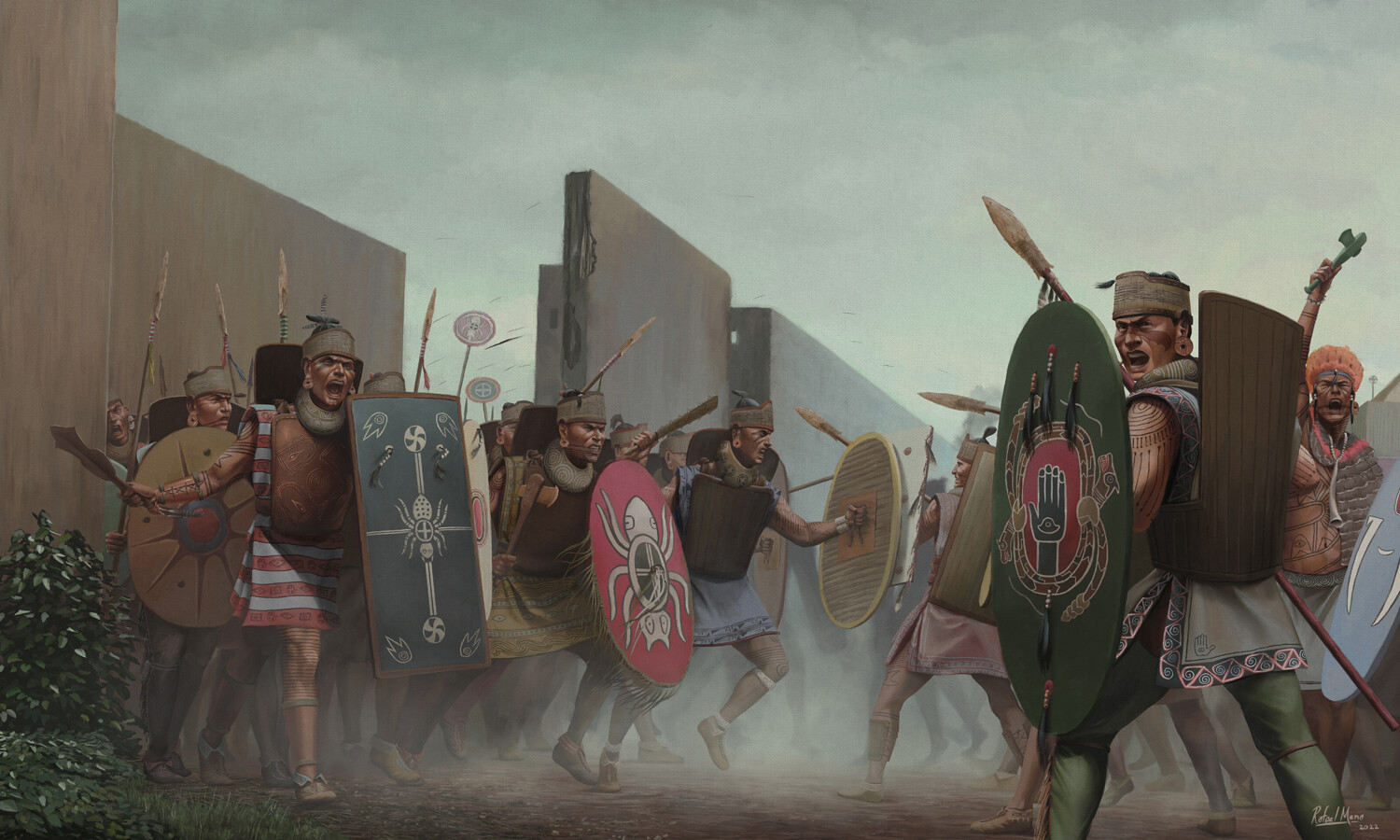
Illustration of a raid in the Mississippian World based on archaeological finds and historical documentation. This interpretation is the end result of intensive data-gathering by archaeologist (and commissioner) Mark Sanders, who presented this piece along with his work at the American Archaeological Society conference, on Mississippian warfare, paraphernalia and weaponry.
Contrary to popular belief about indigenous North American history, the Mississippian region of the continental US was home to a network of kingdoms, and city-states, and polities which influenced and interacted with each other, and with the larger pre-Columbian world for centuries prior to the arrival of European settlers. These states became actively involved in deep political intrigues both within and outside their courts, establishing trade relationships, and most importantly for this piece: engaging in warfare.
Amassing armies in the thousands, the Mississippians waged war in ways no less complex than their Mesoamerican, Andean, and Old World counterparts. They made use of advanced weaponry, tactics, logistical support through long supply lines defined by the flow of the Mississippi and other rivers, making use of brown water fleets and all manner of fortification to gain strategic supremacy over their peers.
The illustration shows an idealized representation of Middle Mississippi armor, with a full range of possible armor constructions and weapon systems (copper and flint weapons, wood armor, leather, and copper plates). An assault on one of these fortifications is observed, where elite warriors from an expansionistic polity attack the defenders of a Muskogean-speaking settlement.
Finished in July 2022